
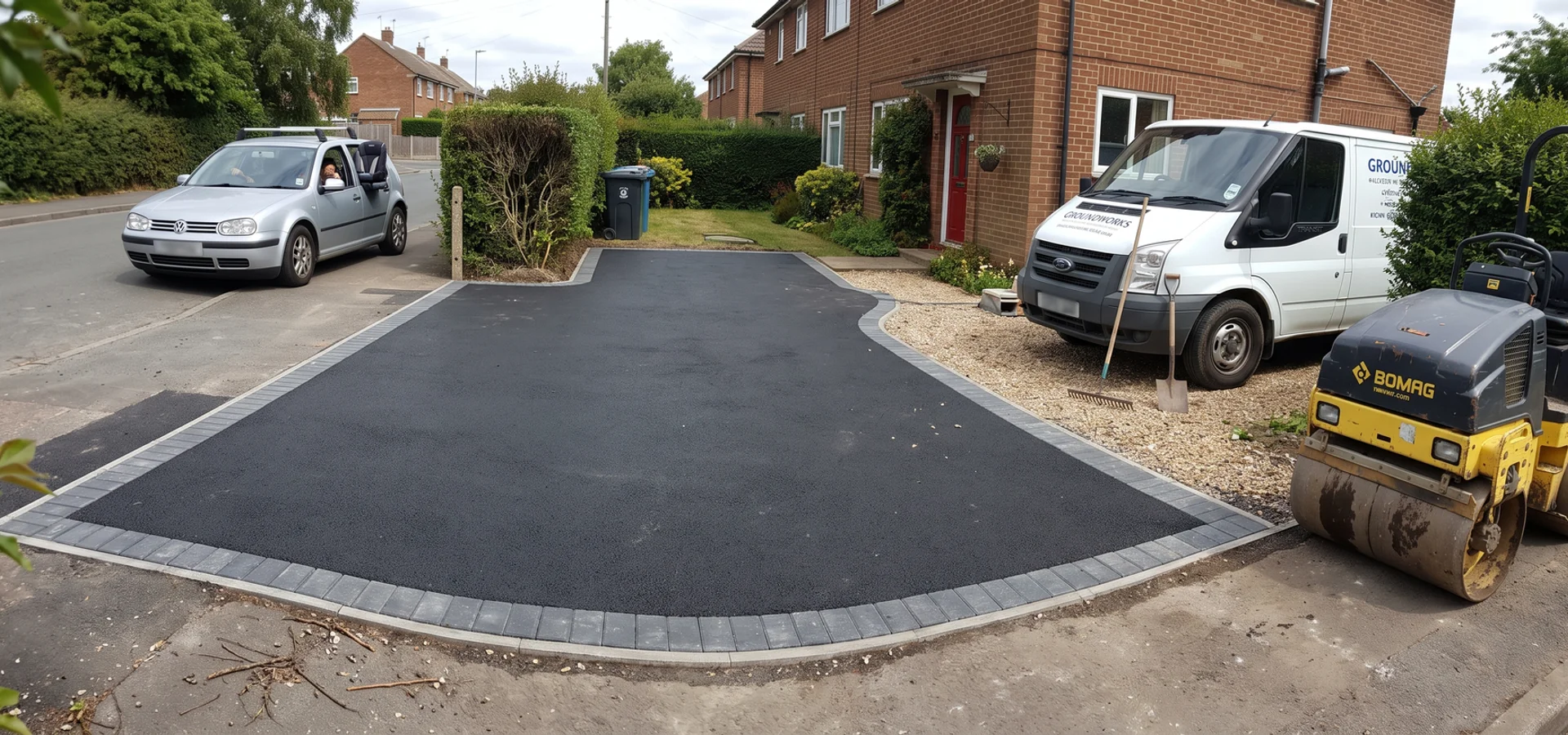
Durable Tarmac Driveways & Resurfacing in Gloucester
New tarmac drives, resurfacing, extensions and repairs, with colour, border and block-paved entrance options.
- 30+ years' experience
- No deposit, pay on completion
- Fully insured and guaranteed
- 4.83/5 on TrustATrader
Free no-obligation survey · No deposit required
- 4.83/5 on TrustATrader
- Fully Insured & Guaranteed
- 24-Hour Enquiry Response
- 30+ Years Experience
- No deposit — pay on completion
What is a tarmac driveway?
A tarmac driveway is a hot-laid asphalt surface, rolled while it is still workable so it compacts into one continuous sheet with no joints for water to get into. It is the surface you already know from every road you drive on, and for the same reason: laid properly, it takes weight, it handles weather, and it costs less per square metre than anything else that lasts as long.
LayPave lays new tarmac driveways, resurfaces tired drives, extends existing ones and carries out road resurfacing across Gloucester and Gloucestershire. A professionally installed tarmac drive is built to last 15 to 25 years or more when laid correctly, with proper excavation, an MOT Type 1 sub-base, base and wearing courses, well compacted with the right drainage falls.
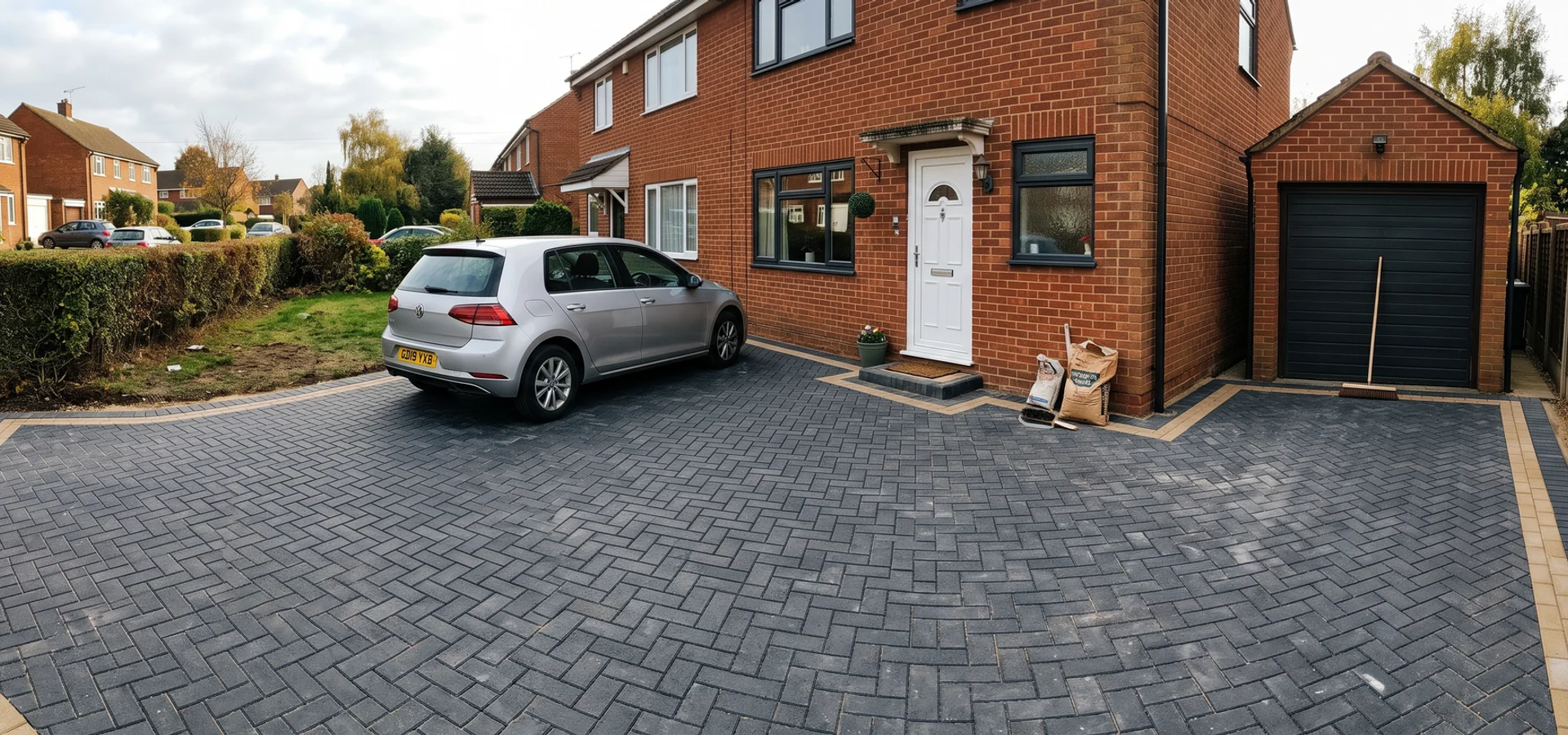
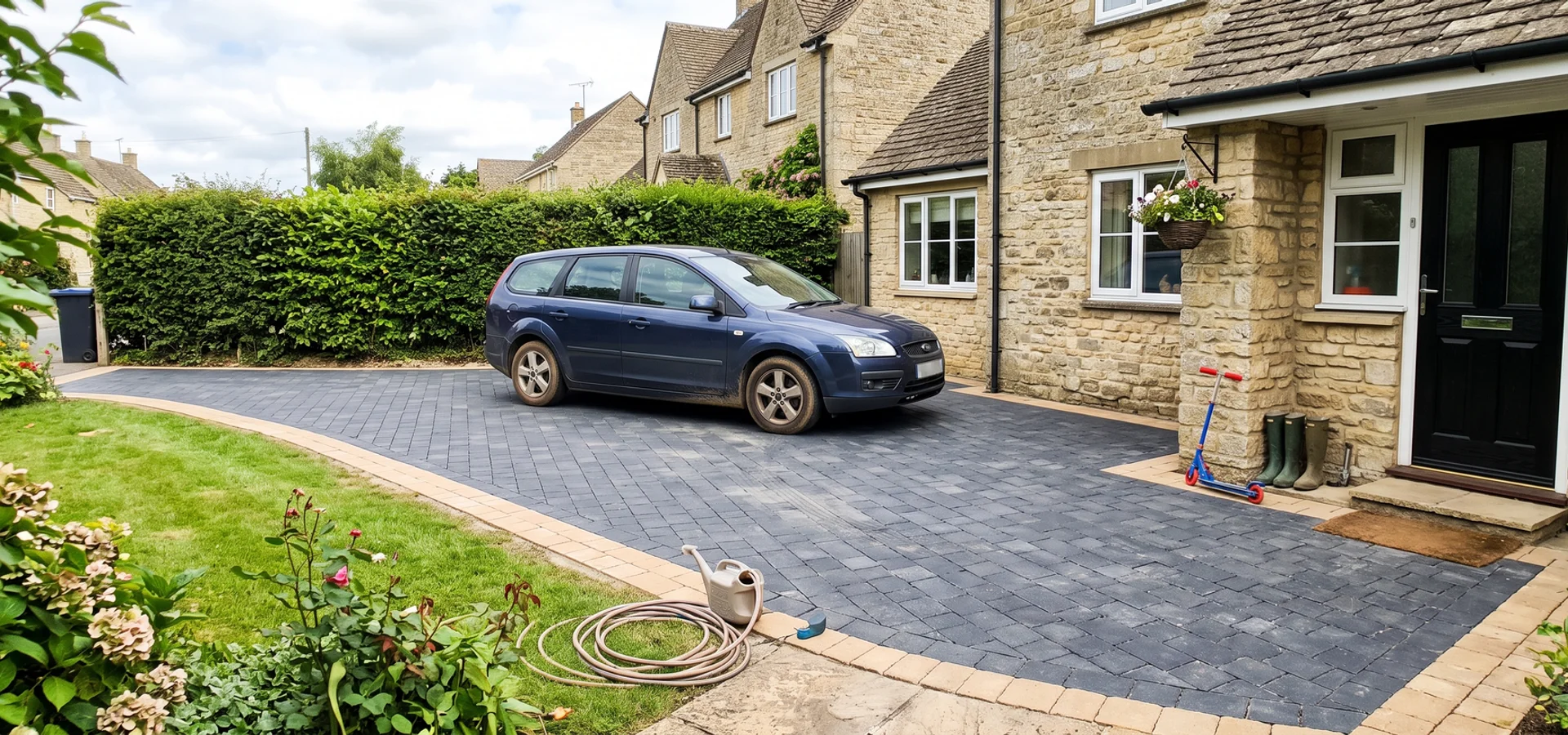
Personalise it with coloured tarmac, decorative borders or a block-paved entrance. Fully guaranteed, with no upfront payment.
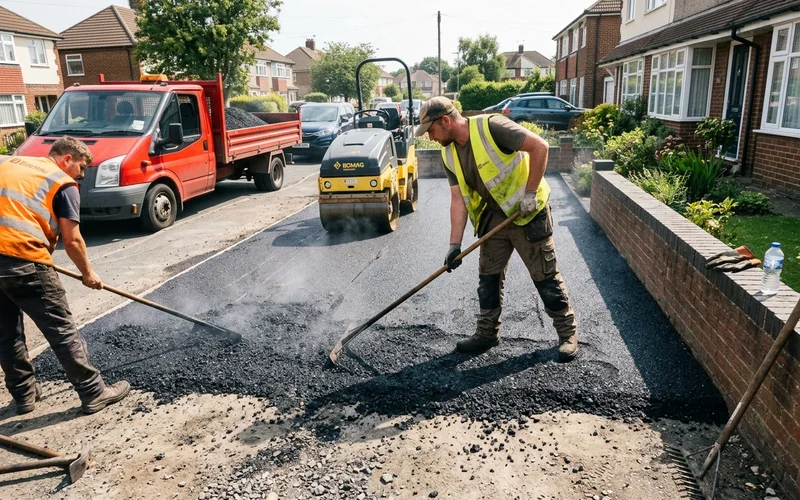
What’s included
- Excavation, or planing off where we are resurfacing a sound base
- Spoil carted away, no skips left sitting on your drive for a fortnight
- MOT Type 1 sub-base laid and compacted in layers to the depth the ground needs
- A bitumen emulsion tack coat between layers so they bond as one
- Base course laid and rolled, then the wearing course on top
- Drainage fall gradient set away from the house, with channel drainage where needed
- Edgings, block paved aprons and border courses where specified
How we build it
Excavation depth depends on the ground and on what the drive has to carry. A domestic drive usually needs 150mm to 250mm out, more where the subsoil is soft clay, which a lot of Gloucestershire is. Anything that will not compact comes out and gets replaced with stone.
The MOT Type 1 sub-base goes in and gets compacted in layers with a vibratory roller. Falls are set at this stage. Getting the fall right at base level means the finished surface follows it naturally, rather than the gang trying to rake a slope into a hot mat that is already cooling.
Then the surfacing itself. A tack coat of bitumen emulsion is sprayed so the layers bond, the base course goes down and is rolled, and the wearing course follows. Both are laid hot and rolled while workable, which is what gives tarmac its density and its anti-slip texture. Where a drive takes heavy or turning traffic we specify a stone mastic asphalt (SMA) wearing course, which holds up better to shoving and rutting than a standard mix. Materials are laid to the BS EN 13108 standard for asphalt mixtures.
Edges are the other thing that decides how long a drive lasts. Tarmac with nothing holding its edge crumbles from the outside in. We finish against existing kerbs, new edgings or a block paved border, depending on what suits the house.
Resurfacing, extensions and repairs
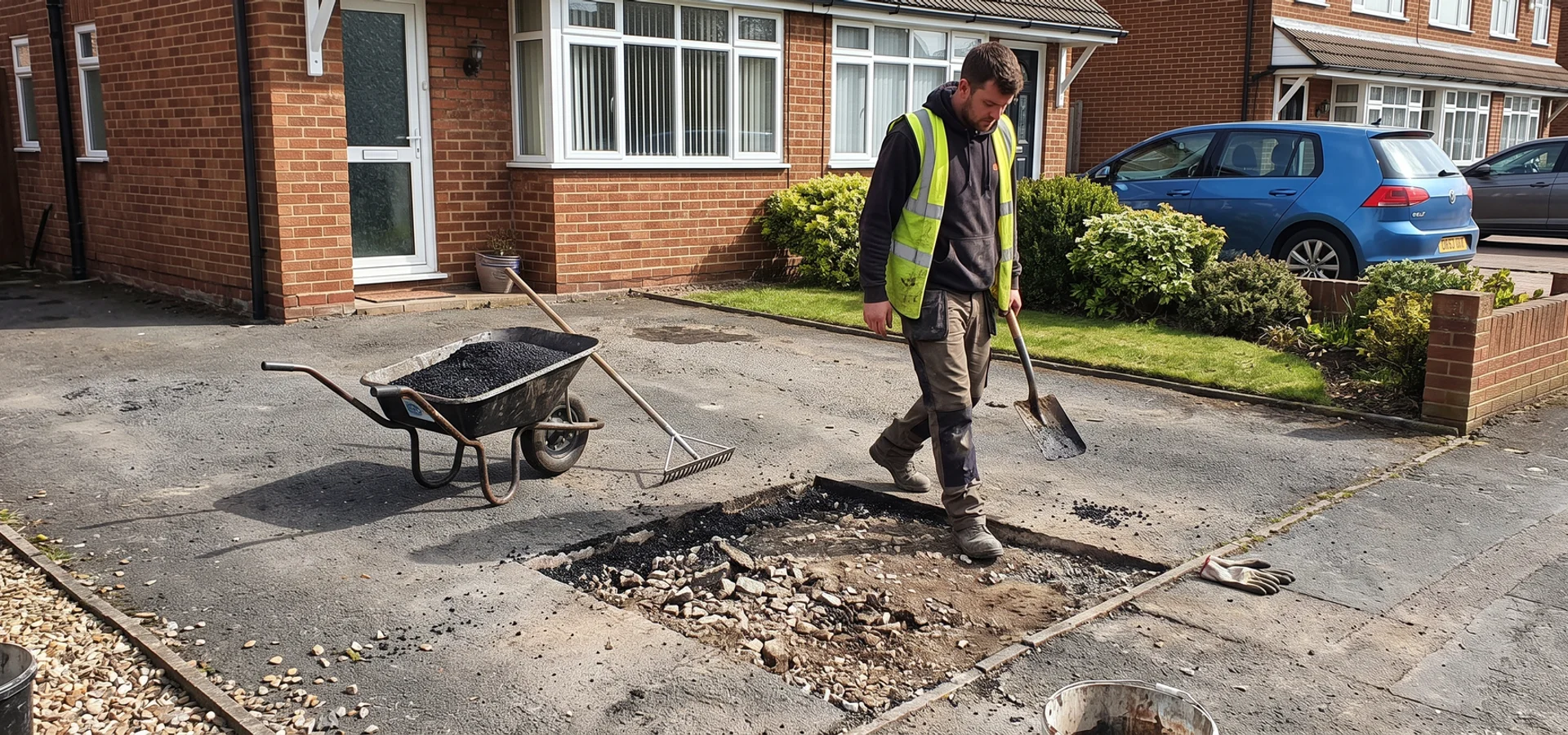
Not every tired drive needs digging out. If the base is sound and only the top has fretted, cracked or faded, planing off and relaying a fresh wearing course gives you a new drive for a fraction of the cost of a rebuild. Where the cracking runs deeper, or where the drive is visibly sinking, the base has already failed and resurfacing over it just buys a season.
We will tell you which one you are looking at, even when the answer is the cheaper job. That honesty is also why we handle a lot of driveway repairs and resurfacing for people who were told by someone else that a full replacement was the only option.
Extensions and widening are common too, usually to fit a second car or a van. The joint between old and new is the weak point, so we cut a clean vertical edge, tack it and roll the new surface into it rather than butting warm tarmac against a broken edge.
Living with it
Tarmac wants very little from you. Sweep it, keep leaf mulch and moss off it in autumn, and get any cracks sealed early rather than letting water get underneath and freeze. Avoid dragging skips or trailers with jockey wheels across it in hot weather, and put a board down under motorbike or caravan stands so the point load does not dent it.
Weighing tarmac up against blocks or resin? Our guide comparing block paving, resin and tarmac sets out where each one wins on cost, drainage and looks.
Included as standard on every job
- New drives, resurfacing, extensions and repairs
- Built to last 15-25 years when laid correctly
- Coloured tarmac and decorative border options
- Block-paved entrance patterns available
- Correct sub-base and drainage falls every time
Pricing
What do tarmac driveways cost in Gloucester?
Tarmac is usually the lowest cost per square metre of the surfaces we lay, but the price still depends on the dig, the depth of the base and how much old surface has to come away. We quote per project after seeing it.
All work is quoted after a free, no-obligation site survey. No deposit is required at any point.
What the quote covers
- Excavation or planing off of the old surface
- MOT Type 1 sub-base, compacted in layers
- Base course and wearing course laid and rolled hot
- Bitumen emulsion tack coat between layers
- Drainage falls and edging detail
- Site clearance and waste removal
What moves the price
- Area in square metres and the shape of the drive
- New build-up versus resurfacing a sound base
- Depth of dig for the ground conditions
- Coloured tarmac or a block paved entrance
- Drainage work such as an ACO channel
- Access for the roller and the tipper
Try our free Driveway Cost Estimator
Get a ballpark cost for a new driveway based on its size and the material you're considering. For a firm price, book a free survey.
Get an instant estimateWhy us
Why choose LayPave for tarmac?
Two layers, not one
A proper drive gets a base course and a wearing course. A single thin skim over old surfacing looks fine for a season and then ruts where the wheels sit.
Falls set before we lay
Water has to go somewhere and it should never be towards your house. We set the drainage fall gradient at base stage, not by chasing it with the rake.
No deposit, ever
No money changes hands until the drive is finished, rolled and you have walked it with us.
Insured and guaranteed
Fully insured, guaranteed workmanship, TrustATrader vetted at 4.83 out of 5, and 30+ years of surfacing behind every job.
How LayPave compares
Against the way this work is commonly quoted and delivered in Gloucestershire.
| Feature | Typical provider | LayPave |
|---|---|---|
| Deposit to start | 20-50% up front | £0 - you pay on completion |
| Build-up | Single thin layer over the old drive | Base course plus wearing course, rolled hot |
| Sub-base | Reused where possible | MOT Type 1 to the depth the ground needs |
| Expected life | 5-10 years on a thin overlay | 15-25 years when laid correctly |
| Cover | Varies by trader | Fully insured, TrustATrader guaranteed |
The process
How our tarmac work runs
- 01
Free survey
We look at levels, drainage and what is under the existing surface, then tell you whether you need a full rebuild or just a resurface.
- 02
Itemised quote
A written quotation splitting out excavation, sub-base, base course and wearing course, so you can see where the money goes.
- 03
Dig and base
Old surface out, spoil carted away, MOT Type 1 sub-base laid and compacted to the right depth with the drainage fall gradient set.
- 04
Lay and roll
Base course, tack coat, then the wearing course, all laid hot and rolled while it is workable. Walk on it the same evening, park on it the next day.
Ready to talk about your tarmac project?
Free site survey, an itemised quote and no deposit. Honest advice either way.
Our work
Tarmac projects across Gloucestershire
Click any photo to see it larger.
Reviews
What customers say about our tarmac work
4.83 out of 5 on TrustATrader, from dozens of homeowners across Gloucestershire.
Our old tarmac drive was cracked and sinking. LayPave dug it out properly, sorted the drainage and re-laid it. Explained everything as they went. 30 years' experience really shows.
Long farm-style drive resurfaced in two days. They set the falls so the water runs off into the verge instead of down to the barn. Not a puddle on it since.
Went for a block paved entrance with tarmac behind it. Best of both, and it cost far less than blocking the whole drive would have.
FAQs
Tarmac questions, answered
How long does a tarmac driveway last?
A professionally installed tarmac driveway is built to last 15 to 25 years or more. That figure assumes a proper excavation, an MOT Type 1 sub-base and both a base course and a wearing course. A thin overlay laid straight onto a failing drive will not get near it.
How soon can I drive on a new tarmac driveway?
You can walk on it the same evening once it has cooled. Leave cars off it for 24 hours, and avoid turning the steering wheel while stationary or parking with a heavy load on a hot day for the first few weeks while it hardens fully.
Can you resurface my drive instead of digging it out?
Sometimes. If the base underneath is sound and the levels still work, resurfacing is quicker and cheaper. If the cracking runs through the base or the drive is sinking, resurfacing just hides the problem for a year. We will tell you honestly which situation you are in.
Can tarmac be a colour other than black?
Yes. Coloured tarmac is available in red, green and buff tones, and a lot of people use it for the entrance apron or a border while keeping the main drive black. A block paved entrance or border course is the other popular way to break it up.
Why do some tarmac drives go grey and loose?
That is the bitumen binder oxidising and the surface fretting, usually on a drive that was laid too thin, laid too cold or laid in the wrong season. Laid at the right temperature and rolled properly, tarmac holds its colour and its texture for years.
Do you do drop kerbs and drainage as part of the job?
We install ACO channel drainage as part of the surfacing work, and we can arrange the dropped kerb crossover you need for legal vehicle access. Mention it at the survey and we will include it on the quotation.
Ready to book your tarmac job?
Free site survey, an itemised quote and no deposit. We aim to reply to online enquiries within 24 hours.
- Free site survey and itemised quote
- No deposit — pay on completion
- Fully insured and guaranteed work